
I know what keeps you up at night.
It’s that gnawing worry about whether you’ve done enough to keep your kids safe. Whether you’ve covered all the bases.
Here’s the thing: between online threats, neighborhood dangers, and everything happening at school, building a real safety plan feels impossible. There’s too much to think about.
I created this guide because parents need something practical. Not fear mongering. Not a list of worst-case scenarios that leaves you paralyzed.
Just clear steps you can actually take.
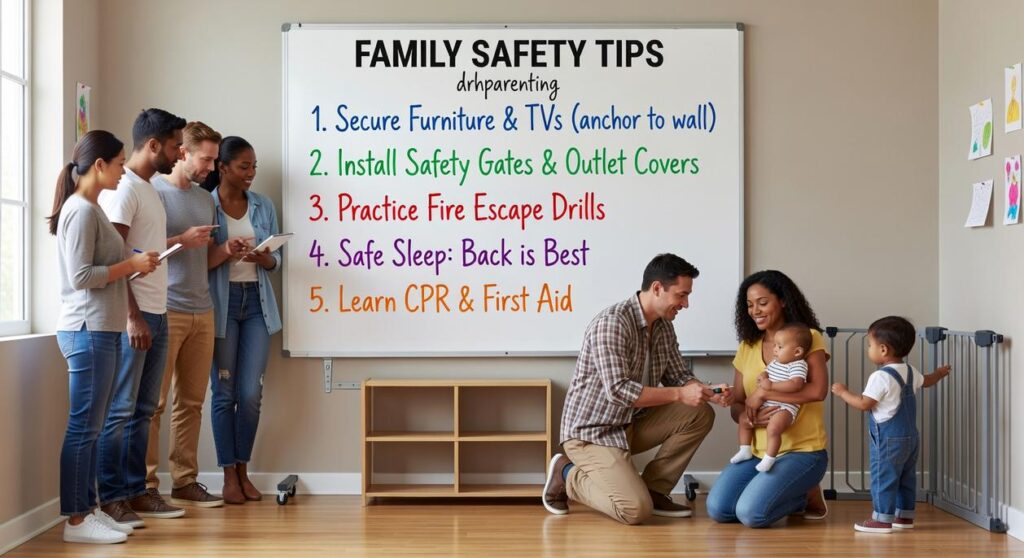
family safety tips drhparenting brings together what actually works. I’ve cut through the noise and pulled together expert advice that you can use today.
This article gives you a framework. You’ll learn how to protect your kids at home, keep them safer online, and prepare them for the world outside your front door.
No overwhelm. No guilt trips about what you should have done yesterday.
Just a straightforward plan you can start using right now.
The Safe Haven: Fortifying Your Home Environment
Beyond the Basics of Childproofing
You’ve probably covered outlets and cabinet locks already.
But the stuff that keeps me up at night? It’s the risks you don’t see coming.
I’m talking about that dresser in your kid’s room. The one they might climb to reach their favorite toy. According to the Consumer Product Safety Commission, a child dies every two weeks from furniture tip-overs. That number hits different when you have kids of your own.
Anchoring heavy furniture and TVs isn’t optional. It takes maybe 20 minutes and costs less than dinner out. You drill the anchor into the wall stud and attach it to the back of the furniture. Done.
The payoff? You sleep better knowing your toddler can’t pull a bookshelf down on themselves.
Window safety is another one people skip. Kids see windows as portals to the outside world (and honestly, they’re not wrong). But furniture near windows becomes a climbing opportunity. Move it away. Install window guards or stops that prevent windows from opening more than four inches.
You get peace of mind. Your kids get to be curious without the risk.
Then there’s storage. Medications, cleaning supplies, anything that could poison or harm a child needs to be locked up. Not just out of reach. Locked. Kids are better climbers than you think.
When you follow family safety tips drhparenting recommends, you’re not just checking boxes. You’re building an environment where your kids can explore safely.
Emergency Preparedness as a Family Habit
Here’s what most parents get wrong about emergency prep.
They think it’s about buying stuff and forgetting about it.
Functional smoke and carbon monoxide detectors on every level of your home are your first line of defense. Test them monthly. Change batteries twice a year (I do mine when we change clocks). Replace the whole unit every 10 years.
The benefit? Early warning that gives your family time to get out safely.
But detectors only work if you know what to do when they go off.
Sit down with your family and create a fire escape plan. Walk through it together. Identify two ways out of every room. Pick a meeting spot outside where everyone gathers so you know who’s safe.
Then practice it. Make it a game for younger kids if you need to.
You’ll be surprised how much calmer you feel knowing everyone knows the plan. And if something does happen, muscle memory kicks in.
Last thing. Build a real first aid kit and learn how to use it. Not just bandaids and antiseptic. Include supplies for burns, cuts that need pressure, and choking incidents. Take a basic first aid class if you haven’t (many are free through local fire departments).
The advantage here is simple. When your kid falls and splits their lip or burns their hand on the stove, you don’t panic. You know exactly what to do while you’re deciding if you need to head to the ER.
That confidence? It changes everything about how you handle the inevitable bumps and scrapes of raising kids.
Digital Guardianship: Navigating Online Risks Together

Communication as Your Primary Tool
I was talking to my daughter last week when she said something that stopped me cold.
“Dad, my friend got a weird message from someone she didn’t know. She deleted it and didn’t tell anyone because she thought she’d get in trouble.”
That right there is the problem.
Kids need to know they won’t lose their phone or get grounded when something creepy happens online. Because if they think reporting means punishment, they’ll just hide it.
I tell parents this all the time. Your goal isn’t to be the internet police. It’s to be the person your kid runs to when things get weird.
Start conversations early about what makes them uncomfortable online. Ask questions like “Has anyone ever sent you something that made you feel icky?” or “Do you know what to do if someone asks for your photo?”
You’d be surprised what they’ll share when you’re not lecturing.
Here’s something most kids don’t get. Everything they post leaves a digital footprint. That’s just a fancy way of saying the internet never forgets.
I explain it like this: “That photo you post today? It could show up in 10 years when you’re applying for a job.”
Suddenly they start thinking twice about what they share.
Now let’s talk about cyberbullying. It’s not just mean comments (though those hurt too). It’s when someone repeatedly targets your kid online to harass or humiliate them.
One mom told me her son was getting group texts calling him names every single day. “I didn’t know what to do,” she said. “He begged me not to make it worse.”
Here’s what I told her, and what I’m telling you.
Your family needs a clear policy. When cyberbullying happens, your kid should block the person immediately, report it on the platform, and tell you or another trusted adult. No exceptions.
Make sure they know this isn’t tattling. It’s protecting themselves.
Practical Rules and Technical Safeguards
Some people say parental controls are invasive and destroy trust.
I disagree.
You can build trust and use tools to keep your kids safer. These aren’t mutually exclusive.
Parental controls on devices, routers, and apps help filter out inappropriate content before it reaches your kid. Think of it as childproofing, but for the digital world.
I’m not saying you need to read every text or track their every move. But age-appropriate filters? Those just make sense, especially for younger kids.
Here’s a rule that’s changed everything in our house: tech-free zones.
No phones in bedrooms. No screens at the dinner table.
At first, my kids pushed back hard. “But everyone else gets to have their phone at night!”
I stuck with it. And you know what? Within a week, bedtime got easier. Dinner conversations actually happened.
Creating these boundaries isn’t about being strict. It’s about teaching them that real life matters too.
Before any app or game gets downloaded, we check it together. I look at the age rating and privacy settings. We read reviews from other parents.
My son wanted to download a game all his friends had. When we looked at the privacy policy together, we saw it collected way more data than we were comfortable with.
“Can we find something similar that doesn’t do that?” he asked.
We did. Crisis averted.
The family safety tips drhparenting approach isn’t about saying no to everything. It’s about making informed choices together.
Look, I know this feels like a lot. But you don’t have to implement everything overnight.
Start with one conversation. Set up one tech-free zone. Check the settings on one app.
Small steps add up. And your kids are watching how you handle this. They’re learning from you what healthy digital habits look like.
For more guidance on building these habits, check out the drhparenting parenting guide drhomey.
You’ve got this.
World-Wise Kids: Teaching Safety Beyond the Front Door
Look, I’m going to be honest with you.
The whole “stranger danger” thing we grew up with? It doesn’t work anymore. Actually, it never really worked.
We taught kids to fear creepy-looking people in vans. But most kids who get into trouble know the person who hurt them. That’s what the data shows us.
So what do we do instead?
Evolving from ‘Stranger Danger’ to Smart Habits
I teach my kids about tricky people.
Not scary strangers. Tricky people.
Because here’s what matters. It’s not what someone looks like. It’s what they do and what they ask.
A tricky person asks a child for help finding a lost puppy. They ask you to keep a secret from your parents. They want you to go somewhere without telling mom or dad first.
Normal adults don’t ask kids for help. We ask other adults.
Try this script with your kids: “If a grownup you don’t know asks you to help them or go with them, you say ‘No thank you’ and walk away fast. Then you tell me or another trusted adult right away.”
Practice it. Role-play in your living room.
What if you get separated at the grocery store? Your child should stay put and look for someone safe. A police officer works. A store employee with a name tag and uniform. Another mom or dad with kids (because predators rarely approach when other parents are watching).
I know some parents think this is too much for young kids. That we’re scaring them unnecessarily.
But I disagree.
Kids can handle way more than we give them credit for. And honestly? Not teaching them these family safety tips drhparenting is what scares me.
Mastering Transportation and Pedestrian Safety
Here’s where I get a little strict.
Some safety rules aren’t up for debate. They’re non-negotiable in my house.
Crosswalks every single time. No exceptions. I don’t care if the street looks empty.
Look left, then right, then left again before crossing. Yes, even in parking lots. Especially in parking lots, actually.
Put the phone away. I see teenagers walking while staring at their screens and it makes my stomach drop.
Car safety is another hill I’ll die on.
Your kid stays in the appropriate car seat or booster until they outgrow it by height and weight. Not by age. Not because their friend doesn’t use one anymore. The laws exist for a reason, and the physics of a crash don’t care about your child’s feelings.
Seatbelts stay on from the moment the car starts until it’s parked and off. Every trip. Even the two-minute drive to school.
Now let’s talk bikes and scooters.
Helmets aren’t optional. I don’t care if your kid complains that it messes up their hair or looks uncool. A properly fitted helmet can be the difference between a scary moment and a tragedy.
And yes, it needs to fit right. Too loose and it’ll slide off when it matters most.
Kids on bikes follow traffic rules just like cars do. Stop at stop signs. Ride with traffic, not against it. Use hand signals when turning.
I get pushback on this sometimes. Parents tell me I’m being overprotective or that kids need freedom to explore.
Maybe they’re right about the freedom part.
But teaching safety skills isn’t the opposite of freedom. It’s what makes real freedom possible.
Building a Lasting Culture of Safety
You came here to protect your kids better.
We covered the three areas that matter most: keeping them safe at home, online, and out in public. Together these form a complete framework you can actually use.
Here’s the truth. We can’t eliminate every risk our children will face. But we can give them the knowledge and confidence to handle whatever comes their way.
That’s what makes this approach work.
When you build a family culture of awareness and open communication, it sticks. It’s way more effective than laying down rules based on fear (which kids will eventually push back against anyway).
Start small. Have one conversation today about something that matters. Practice one safety drill this week. Maybe it’s what to do if someone follows them or how to spot a suspicious message online.
Make safety an ongoing dialogue in your home. Keep it positive and keep it real.
Your kids are watching how you handle these topics. Show them that safety isn’t about being scared. It’s about being prepared.
family safety tips drhparenting gives you the tools to make this happen. The rest is up to you.
One conversation at a time. That’s how you build something that lasts.
